


Precision Test Services for the Asphalt Industry
Data quality matters, and our experts at Asphalt Institute strive for excellence in every asphalt test we perform. With a broad range of analytical capabilities, our professional engineers, accomplished scientists, and certified technicians deliver reliable, independent assurance testing for the asphalt industry.
Our Process
1
Connect with Our Staff
Start by reaching out with your testing request. Whether you need a Certificate of Analysis (COA), applied research support, product evaluation, or forensic analysis, our staff will collaborate with you to design the right testing plan for your needs.
2
Submit Materials
Once your plan is finalized, send your sample materials to our laboratory. Upon receipt, samples are logged into our Asphalt Institute LabPortal, and you’ll receive an automatic confirmation email.
3
Analysis and Reporting
After the completion of testing, results are compiled and reviewed by our experts. You’ll receive an email from Asphalt Institute LabPortal with your final test report.
4
Follow-Up Support
Our laboratory staff are available to interpret your results and provide recommendations for next steps or future testing.
The Asphalt Institute laboratory has been accredited by the AASHTO Accreditation Program (AAP) since 1997 and is currently accredited in:
- AASHTO R18 Quality Management System
- Asphalt Binder
- Emulsified Asphalt
- Asphalt Mixtures
- Aggregate
Asphalt Institute members receive discounted testing rates.
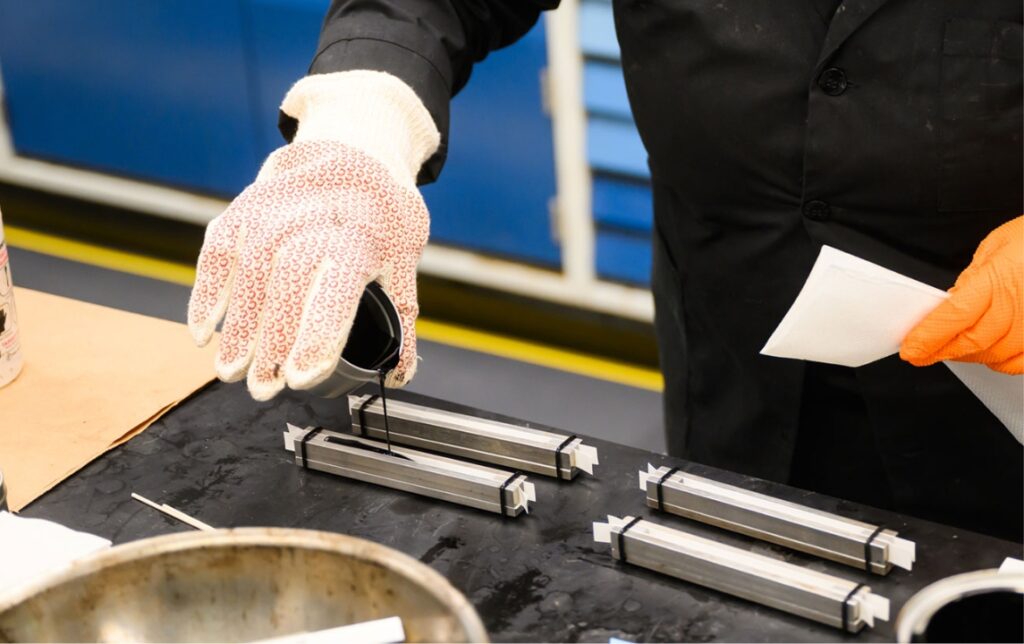
Tests Offered
Asphalt Binder
- AASHTO M320 / M332 Performance Grade (PG) verification and determination
- Laboratory binder aging
- Non-PG testing (Elastic Recovery, Softening Point, Solubility, and more)
- Advanced rheological characterization and master curve development
- Failure testing using the Asphalt Binder Cracking Device (ABCD)
Asphalt Binder Tests
| TEST NAME | AASHTO Method | ASTM Method |
|---|---|---|
| Performance Grade (PG) Verification | M 320 | D6373 |
| Performance Grade (PG)Determination | M 320/R 29 | D6373/D7643 |
| Multiple Stress Creep Recovery (MSCR) Grade Verification | M 332 | D8239 |
| Flash Point - Cleveland Open Cup | T 48 | D92 |
| Rotational Viscosity | T 316 | D4402 |
| Dynamic Shear Rheometer (DSR) | T 315 | D7175 |
| Multiple Stress Creep Recovery (MSCR) | T 350 | D7405 |
| Linear Amplitude Sweep (LAS) | T 391 | - |
| Temperature-Frequency Sweep | - | - |
| Master Curve Generation and Analysis | - | - |
| Bending Beam Rheometer (BBR) | T 313 | D6648 |
| Delta Tc Determination | R 118 | - |
| Rolling Thin-Film Oven (RTFO) Aging & Mass Change | T 240 | D2872 |
| Pressure Aging Vessel Aging (PAV) - 20 hour | R 28 | D6521 |
| Pressure Aging Vessel Aging (PAV) - 40+ hour | - | - |
| Thin-Film Oven (TFO) Aging | T 179 | D1754 |
| Specific Gravity | T 228 | D70 |
| Solubility | - | D2042 |
| Inorganic Mineral Matter | T 111 | D8078 |
| Penetration | T 49 | D5 |
| Vacuum Viscosity | T 202 | D2171 |
| Ring-and-Ball Softening Point | T 53 | D36 |
| Polymer Separation by Softening Point or DSR | - | D7173 |
| Ductility | T 51 | D113 |
| Elastic Recovery | T 301 | D6084 |
| Force Ductility | T 300 | - |
| Double-Edge-Notched Tension (DENT) | T 405 | - |
| Asphalt Binder Cracking Device (ABCD) | T 387 | - |
| Additive/Polymer Blending | - | - |
| Fourier-Transform Infrared Spectroscopy (FTIR) | - | - |
| Polymer Content by FTIR | T 302 | - |
Emulsified Asphalt
- Standard specification testing (Saybolt Viscosity, Storage Stability, and more)
- Residue recovery by distillation or evaporation (high or low temperature)
- Residue testing
Asphalt Emulsion Tests
| Test Name | AASHTO Method | ASTM Method |
|---|---|---|
| Grade Verification of Anionic Emulsified Asphalts | M 140 | D977 |
| Grade Verification of Cationic Emulsified Asphalts | M 208 | D2397 |
| Grade Verification of Polymer-Modified Emulsified Asphalts | M 316 | - |
| Settlement and Storage Stability | T 59 | D6930 |
| Oversized Particles | T 59 | D6933 |
| Particle Charge | T 59 | D7402 |
| Viscosity - Saybolt Method | T 72 | D7496 |
| Viscosity - Paddle Viscometer Method | T 382 | D7226 |
| Demulsibility | T 59 | D6936 |
| Cement Mixing | T 59 | D6935 |
| Residue - Distillation Method | T 59 | D6997 |
| Residue - High Temperature Evaporation Method | T 59 | D6934 |
| Residue - Low Temperature Evaporation Methods | R 78 | - |
| Density | T 59 | - |
| Float Test | T 50 | D139 |
Asphalt Mixture & Aggregate
- Aggregate gradation
- Mixture volumetric analysis
- Laboratory mixture aging
- Hamburg Wheel Tracker (HWT), Flexural Beam Fatigue, Indirect Tensile Cracking Test (IDEAL-CT), and more
- Binder extraction and recovery
Asphalt Aggregate Tests
| Test Name | AASHTO Method | ASTM Method |
|---|---|---|
| Sampling of Aggregates | R 90 | D75 |
| Aggregate Sample Reduction for Testing | R 76 | C702 |
| Fine Aggregate (No. 200 Sieve) Determination | T 11 | C117 |
| Specific Gravity and Absporption of Fine Aggregate | T 84 | C128 |
| Specific Gravity and Absporption of Coarse Aggregate | T 85 | C127 |
| Sieve Analysis of Fine and Coarse Aggregates | T 27 | C136 |
| Total Moisture Content by Drying | T 255 | C566 |
| Uncompacted Void Content of Fine Aggregate | T 304 | C1252 |
| Uncompacted Void Content of Coarse Aggregate | T 326 | - |
| Mechanical Analysis of Extracted Aggregate | T 30 | D5444 |
| Plastic Fines in Graded Aggregates by Sand Equivalent | T 176 | D2419 |
| Fractured Particles in Coarse Aggregate | T 335 | D5821 |
| Flat/Elongated Particles in Coarse Aggregate | - | D4791 |
Asphalt Mixture Tests
| Test Name | AASHTO Method | ASTM Method |
|---|---|---|
| Superpave Volumetric Mix Design | M 323 | - |
| Mixture Conditioning of Hot Mix Asphalt | R 30 | - |
| Mixture Sample Reduction for Testing | R 47 | - |
| Long-Term Laboratory Conditioning of Asphalt Mixtures | R 121 | - |
| Sampling Bituminous Paving Mixtures | - | D979 |
| Theoretical Maximum Specific Gravity | T 209 | D2041 |
| Bulk Specific Gravity - SSD Method | T 166 | D2726 |
| Bulk Specific Gravity - Vacuum Sealing Method | T 331 | D6752 |
| Percent Air Voids in Compacted Mixtures | - | D3203 |
| Percent Air Voids in Compacted Dense and Open Mixtures | T 269 | - |
| Thickness or Height of Mixture Specimens | - | D3549 |
| Relative Density Using Superpave Gyratory Compactor | T 312 | D6925 |
| Moisture Content - Oven Method | T 329 | - |
| Effect of Moisture on Asphalt Mixtures | - | D4867 |
| Moisture-Induced Damage Resistance | T 283 | - |
| Quantitative Extraction of Asphalt Binder from Mixtures | T 164 | D2172 |
| Rotary Evaporator Recovery of Asphalt Binder - Toluene Method | - | D7906 |
Asphalt Mixture Performance Tests
| Test Name | AASHTO Method | ASTM Method |
|---|---|---|
| AMPT - Dynamic Modulus | T 378 | - |
| AMPT - Dynamic Modulus Master Curve Generation | R84 | - |
| AMPT - Flow Number | T 378 | - |
| AMPT - Cyclic Fatigue | T 400 | - |
| AMPT - Low Temperature Indirect Tensile Creep and Strength (IDT) | T 322 | - |
| AMPT - Small Specimen Method | TP 132 | - |
| AMPT - Fracture Energy using Disk Compact Tension (DCT) | - | D7313 |
| Flexural Beam Fatigue | T 321 | - |
| Hamburg Wheel Tracking (HWT) | T 324 | - |
| IFIT Using Semicircular Bend Geometry (SCB) | T 393 | - |
| Indirect Tensile Strength (IDT) | - | D6931 |
| Indirect Tensile Cracking Tolerance (IDEAL-CT) | - | D8225 |
| Indirect Tensile Rutting Tolerance (IDEAL-RT) | - | D8360 |